

Eudaimonia: A Life Well Lived
Start paying attention now before it's too late.

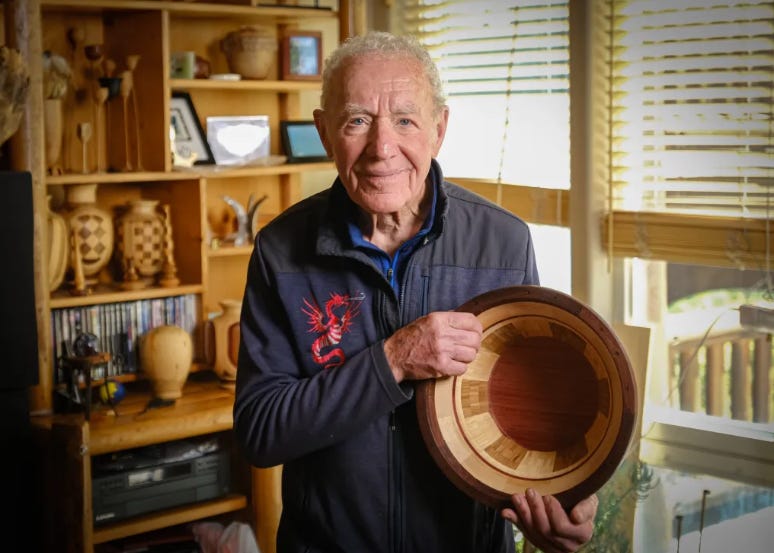
I met Jack at my gym in Park City on a Friday morning this January. Currently 86 years old, he almost immediately shared an audacious goal with me: dying at 106. Lifeforce absolutely beamed straight out of his being as he told me about those 20 years he still has to live.
When I told Jack that my grandmother had just turned 98 he said, “Can she still read? That’s what really matters to me.” Yes — she’s still sharp as a tack (though certainly pretty hard of hearing at this point). I don’t know about you, but if I’m going to live that long I better be able to enjoy a good book still.
Jack went on to tell me that when he’s 106, we’re going to have a hot chocolate together. Twenty years from now, I’ll be 55. “You’ll still be a baby,” he said. Perspective is wild.
He went on to serenade me with life lessons that somehow mean so much more coming from a source like Jack: “You have time but you need to start now. You have to stop to look and feel. Rain, shine, snow, whatever — each day is a gift. Where you are, you’re just at the beginning. It matters now. Stop to pay attention to everything.” This transmission hit me hard enough that I voice noted myself all the details I could remember as soon as I got to my car.
Before he walked away, I asked his name. “I’m Jack, and I’m an artist. Look me up!” Sure enough, my new friend is an accomplished woodworker who seems to have drunk from the waters of something akin to the fountain of youth (or maybe just lots of water).
I’ve been thinking about Jack intermittently ever since, largely because he seemed to have already answered a question I think about often: what does it mean to live well?
Aristotle described eudaimonia, often incorrectly translated as “happiness.” The Greek roots give us a more textured picture: eu, meaning “well” or “good,” and daimōn, meaning something like one’s inner spirit or guiding force. To be eudaimon, then, is to live in accordance with one’s daimōn — one’s deepest, most essential self. It isn’t the happiness of a pleasant afternoon; it’s something more like the happiness of a life that has been genuinely, fully inhabited.
Aristotle distinguished this from hedonia, the pleasure derived from external circumstances like sensory satisfaction or comfort. While he argued that both matter, Aristotle also taught that hedonia alone doesn’t constitute a flourishing life. Eudaimonia requires activity in accordance with virtue and one’s highest capacities, a kind of continuous becoming-toward-excellence. It demands effort, and that we actually show up to our own lives.
This distinction might resonate if you’ve ever achieved something you thought would make you happy and found that the happiness, when it arrived, was thinner than expected. Perhaps, on the other hand, you’ve noticed that some of the most genuinely satisfying moments of your life had nothing to do with pleasure in the conventional sense. Maybe, instead, they were difficult or demanding, or required you to be extremely present but extremely uncomfortable.
Modern life is exceptionally good at producing hedonic experiences and remarkably poor at producing eudaimonic ones. We have more entertainment, more comfort, and more convenience than any previous generation in human history, and we are, I would argue, by-and-large not particularly flourishing. When we optimize exclusively for pleasure and ease, we tend to evacuate the very experiences destined to make a life feel meaningful in retrospect.
Discussions of eudaimonia tend to stay comfortably in the shallow waters of a societal desire to operationalize “wellbeing.” How should we measure it? How can we increase it? What makes X group more “well” and happy than others? Here are 10 easy lifestyle upgrades to “live your best life.” Or, alternatively, we could easily find ourselves in a deep but ultimately unsatisfying (for me) conversation about virtues and ethics. So here’s my hot take: the question of what it means to live well cannot be fully answered without accounting for the fact that life ends. Without the recognition of that knowledge, attempts at chasing a life well lived are likely to remain shallow and unfruitful.
To review: life has a beginning and an end; you are born, you die, and hopefully the middle part is more rad than not.
Think about what it means to describe a life as well-lived. We tend to use that phrase most readily in the context of death — at funerals, in obituaries, and in reflections that follow loss. There’s a reason for this. The shape of a life only becomes fully legible in light of its completion. A story’s meaning is always partly determined by its ending; that’s not a pessimistic observation, it’s a narratological one.
Martin Heidegger says it better. His concept of Being-towards-death—the recognition that death is our most ownmost, non-relational, inevitable possibility—was not an invitation to despair, it was an invitation to wake up. Or, in the words of Irvin Yalom, “though the physicality of death destroys us, the idea of death saves us.” Recognition of our mortality shifts something in how we move through the world. What initially felt like permanent fixtures reveal themselves as contingent; what had seemed trivial can become urgent; what we’d been postponing acquires a weighty urgency.
The point is that death, when we actually let ourselves look at it, has the peculiar effect of clarifying what matters. It narrows things down, pushing the trivial aside and leaving only the essential standing.
This is why the eudaimonia question is, at its root, an existential question: it belongs to the category of questions about existence itself, questions that only become fully answerable (insofar as they are answerable at all) when we are willing to hold our own finitude in view.
In an attempt to tie a bow on this discussion, here’s my distillation of what it might mean to live a good life.
I think a lot about authenticity and presence in relation to this. Authenticity, in the existential sense, isn’t about self-expression or personal branding. It’s about living in a way that is genuinely one’s own, that reflects intrinsic values rather than borrowed ones, true desires rather than socially approved approximations. Heidegger described living authentically as living in accordance with one’s ownmost possibilities, and he was clear that this becomes possible only when we stop using distraction and busyness as a way to avoid confronting the reality of our situation.
Presence, then, follows from authenticity. To be present is to actually be here, not anesthetizing the uncomfortable parts of experience with the remarkable array of tools modern life provides for that purpose. Heidegger’s being-in-the-world, the idea that human existence is always already embedded in and engaged with a world of practical significance, points to exactly this kind of engaged, attentive dwelling in one’s own life. Bugental, drawing on this tradition, placed the cultivation of presence at the center of what it means to live and work as a fully realized human being.
And meaning, in turn, seems to be the actual currency of eudaimonia. Meaning—the felt sense that one’s life has coherence, that it matters, and that it connects to something beyond immediate self-interest—is what the existential-humanistic tradition, from Bugental to Yalom to Schneider, has consistently identified as the precondition for genuine psychological flourishing. Finding this kind of meaning in life is, I think, almost impossible without some reckoning with the fact that it will end. This pressure of an ending is what gives a life its shape.
Jack is most certainly not a man trying his best to ignore his inevitable demise. He set his own expiration date to 2046, and even if he doesn’t make it that far I get the sense that he’ll live each of his remaining days to the fullest. Watching him lift weights next to me that morning though, I had absolutely no trouble believing that he’ll achieve his goal and that we’ll share that hot chocolate in 20 years. Jack has looked at the full shape of his life, confronted its end, and is living accordingly. Rain, shine, snow, whatever. Each day is a gift. Stop to pay attention to everything.
The good life, I suspect, is less a destination than a continuous act of attention: one that becomes possible, paradoxically, only when we stop looking away from the fact that it ends.
Memento vivere.
This is beautiful! If there is one thing I have learned in the last few years, it’s that choosing to live authentically is SO IMPORTANT.
Beautiful.
Presence found me when I was 17, and has gently (sometimes with a touch nudge) guided me since. With less and less "me" and much more Presence.
I often tell young folks like yourself - I'm 73, and I don't think it's too likely I'll make it to 106, but 20 years of healthy functioning seems pretty much in the cards (my Dad was totally mobile and sharp till around 95, and we have quite a few 90-ers in the recent family past as well)
So, I don't know your age, but I"ll pick one - say you're 33.
Now imagine you KNOW beyond a shadow of a doubt that on your 53rd birthday, you will go to sleep and not wake up. Very gentle.
How would that affect how you live right now?
Then think of the great French mystic, Jean Pierre de Caussaude who wrote of the present moment as a "sacrament," much as Meister Eckhart (who inspired Eckhart Tolle) told us to discover the timeless eternal in every moment of time, thus experiencing infinite fullness in each moment.
What is it then, to be - to be here, to be, here, now?
I"ll leave you with Jim Finley's working of a verse from the psalms;
Be still and know that I am God
Be still and know that I am
Be still and know
Be still
Be